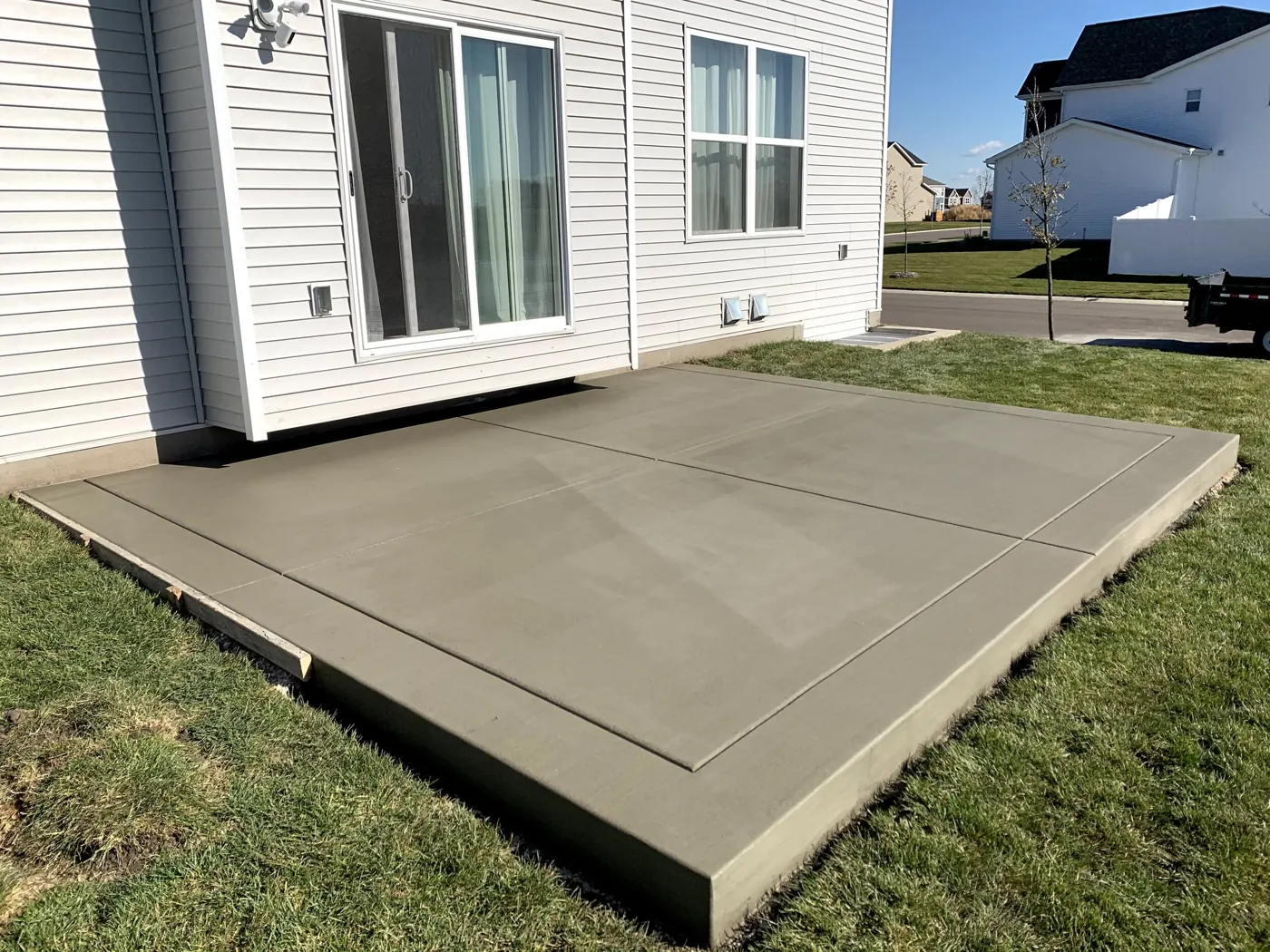
How much does a concrete patio cost in Billings, MT?
Concrete Network’s 2026 cost guide puts a typical 288 square foot patio at about $3,200, roughly $11 per square foot. Most patios that size land between $1,440 and $5,200. Plain concrete with no decorative finish or color runs $5 to $8 per square foot. Tearing out an old patio or regrading the yard pushes the total higher.
These are published market ranges, not our prices and not a quote. What sits under an old slab and how close the truck can get both move the real number. We pour concrete patios, sidewalks and steps across Billings, Laurel, Lockwood and the Yellowstone Valley.
What does a concrete patio cost by size?
Concrete Network’s 2026 table puts a 12 by 12 patio at $900 to $3,000. A 10 by 20 runs $1,200 to $3,600. A 20 by 20 runs $3,200 to $7,200, labor and materials included. The guide’s typical patio is 288 square feet, with an average of $3,200.
| Patio size | Square feet | Published range |
|---|---|---|
| 12 by 12 | 144 | $900 to $3,000 |
| 10 by 20 | 200 | $1,200 to $3,600 |
| Typical patio | 288 | $3,200 average, most between $1,440 and $5,200 |
| 20 by 20 | 400 | $3,200 to $7,200 |
The same guide prices plain design, with no color or decorative work, at $5 to $8 per square foot. At that rate the typical 288 square foot patio works out to about $1,440 to $2,300. Today’s Homeowner puts the average higher, at $3,960, with a range of $490 to $9,600.
What sets the price of a patio?
Size and the site drive the price. Bigger patios usually cost less per square foot, while some contractors charge a minimum total on small pads. Grading or demolition pushes the number up, and so does a backyard the truck cannot reach. Straight edges cost less to form than curves.
If the truck cannot reach a backyard patio, the concrete gets pumped or carried in. Today’s Homeowner notes that ready-mix delivery services often charge extra for pumping. The same guide puts grading an uneven yard at $500 to $3,500.
For the finish, Concrete Network names a broom finish as the most affordable option. The National Ready Mixed Concrete Association (NRMCA) recommends a broom finish outdoors for traction. Montana DOT specifies one on the sidewalks it builds.
Concrete Network notes that many contractors offer a better price per square foot on larger projects. If a new driveway is on the list too, our guide to concrete driveway cost covers that side.
What do tear-out and reinforcement add?
Removing an old patio adds about $2 to $6 per square foot, per Today’s Homeowner. Tearing out and disposing of a 300 square foot slab runs $600 to $1,800, depending on transportation and disposal fees. Wire mesh adds about $0.50 per square foot. Rebar runs around $1 per foot of bar.
| Item | Published cost | Worked on a 288 sq ft patio |
|---|---|---|
| Tear out and dispose of an old patio | $2 to $6 per sq ft | 288 × $2 = $576, up to 288 × $6 = $1,728 |
| Wire mesh | about $0.50 per sq ft | 288 × $0.50 = $144 |
| Rebar | around $1 per foot of bar | depends on bar spacing |
| Grading an uneven yard | $500 to $3,500 | a flat range, not per sq ft |
| Worked total for a replacement | $3,200 average new patio, plus tear-out and mesh | $3,200 + $576 + $144 = $3,920, up to $3,200 + $1,728 + $144 = $5,072 |
That worked total is arithmetic on published figures, not a quote. It leaves out grading and rebar, which depend on the yard and the design.
Mesh and rebar do not stop cracks. NRMCA says reinforcement placed in the right spot keeps them narrower. Joints are what control where cracks form.
When a patio has cracked through or sunk toward the house, the fix is concrete removal and replacement. We break out the old slab, haul it off, rebuild the base and pour new. We do not lift sunken slabs. If one section has failed and the rest is sound, concrete repair by replacing that section can be enough.
What base and thickness does a patio need in Billings?
A patio here needs firm, compacted ground and about 4 inches of concrete sloped away from the house. Quikrete’s patio guide calls a 4 inch slab generally suitable and sets the slope at 1/8 inch per foot. NRMCA says to strip out topsoil and soft spots, then compact the soil or fill underneath.
Frost reaches deep here. The City of Billings sets a 42 inch frost depth for foundations. A patio sits right at the surface, well inside that zone.
So the work goes into the ground under the slab. NRMCA says uniformly compacted subgrades help prevent cracking, and the subgrade should slope for drainage. Montana DOT’s sidewalk spec works the same way. It compacts the subgrade, then places and compacts a gravel base.
Today’s Homeowner’s $3,960 average is for a basic 4 inch patio. A patio that will hold a hot tub or a parked vehicle is a heavier slab. Our guide to concrete slab cost covers that thickness math.
How do joints and the mix handle Montana winters?
Joints decide where a patio cracks, and entrained air protects the surface from flaking. NRMCA caps joint spacing at 24 to 36 times the slab thickness, about 10 feet on a 4 inch slab. For exterior slabs that freeze and see deicers, it recommends 4,000 psi concrete with about 6 percent entrained air.
NRMCA calls joints “pre-planned cracks.” It recommends a 15 foot maximum between them. Panels should be close to square, no more than 1.5 times as long as they are wide.
Each cut should go at least a quarter of the way through the slab. Where a patio meets the house wall or a sidewalk, an isolation joint lets each piece move on its own.
Entrained air is millions of tiny bubbles that give freezing water room to expand. Montana DOT’s spec puts an air-entraining agent in its mix designs unless a contract says otherwise.
Deicers hit new concrete hardest, since it tends to be saturated and lower in strength. NRMCA’s advice is to skip deicing chemicals the first winter and use clean sand for traction. It warns against ammonium and magnesium deicers, which it says destroy concrete surfaces.
Do you need a permit for a patio in Billings?
The City of Billings permit FAQ does not name patios. It says a building permit is required for almost any construction on private property. Its no-permit list includes sidewalks or driveways that will not support a structure and sit entirely on private property. Decks and parking lots are on the list that needs a permit.
Patios are not on either list, so ask the City’s Building Division before the forms go up. Outside city limits, the FAQ says the State of Montana governs, and it lists (406) 841-2056 for more information.
When can a patio be poured in Billings?
Late spring through early fall is the practical window. Montana DOT calls it cold weather concreting when the forecast shows air below 35 degrees at any point during curing. It does not allow concrete on a frozen base or subgrade. NRMCA urges caution with outdoor pours from late fall to early spring.
Shoulder-season pours can work with protection. Montana DOT’s cold weather plans spell out the insulating blankets or enclosures that protect the concrete. Its spec also has ice and snow cleared off the forms and subgrade first.
NRMCA says to start curing as soon as possible. That means a sprayed curing compound, or damp burlap that keeps the slab moist for at least 3 days.
Is a concrete patio cheaper than a wood deck?
Yes, on published numbers: Today’s Homeowner starts a basic poured patio at $8 per square foot. It puts even the most affordable wood decks around $15, and Concrete Network prices wood decks at $15 to $40. On a 288 square foot footprint, that is about $2,300 in concrete against $4,300 or more in wood.
Decks can still be the better choice on uneven ground or for an elevated space, Today’s Homeowner notes. Inside Billings, decks are on the City’s permit list by name.
FAQ
How much does a concrete patio cost in Billings, MT? Concrete Network’s 2026 guide puts a typical 288 square foot patio at about $3,200, with most between $1,440 and $5,200. Plain design runs $5 to $8 per square foot. Today’s Homeowner’s average is $3,960. These are published market ranges, so a real price needs an on-site look.
How much does a 20x20 concrete patio cost? Concrete Network’s table puts a 20 by 20 patio, 400 square feet, at $3,200 to $7,200 with labor and materials. Tearing out an old one adds $800 to $2,400 at Today’s Homeowner’s $2 to $6 per square foot. Access and grading can move it further.
How much does it cost to remove an old concrete patio? Today’s Homeowner puts removal at $2 to $6 per square foot. Tearing out and disposing of a 300 square foot slab runs $600 to $1,800, depending on transportation and disposal fees. We break out failed patios, haul them off, rebuild the base and pour new concrete. We do not lift sunken slabs.
How thick should a concrete patio be in Montana? Quikrete’s patio guide calls a 4 inch slab generally suitable, sloped away from the house 1/8 inch per foot. On a 4 inch slab, the National Ready Mixed Concrete Association puts joints about 10 feet apart. For exterior slabs that freeze and see deicers, it recommends 4,000 psi concrete with about 6 percent entrained air.
Do I need a permit to pour a patio in Billings? The City of Billings permit FAQ does not name patios. It requires a building permit for almost any construction on private property, decks and parking lots included. Its no-permit list includes sidewalks or driveways that support no structure and sit entirely on private property. Ask the Building Division before you pour; outside city limits, the State of Montana governs.
Is a concrete patio cheaper than a wood deck? Yes, on published numbers. Today’s Homeowner starts a basic poured patio at $8 per square foot. It puts the most affordable wood decks around $15, and Concrete Network’s range runs to $40. On 288 square feet, that is about $2,300 in concrete against $4,300 or more in wood.
Get a number for your patio
Square footage gets you a bracket, and the site sets the rest. For new concrete patios around Billings and the Yellowstone Valley, call (406) 717-4103. Estimates are free. We look at the job in person and put the price in writing.
Want a number for your own project?
We look at the job in person and hand you a free written quote across Billings & the Yellowstone Valley.