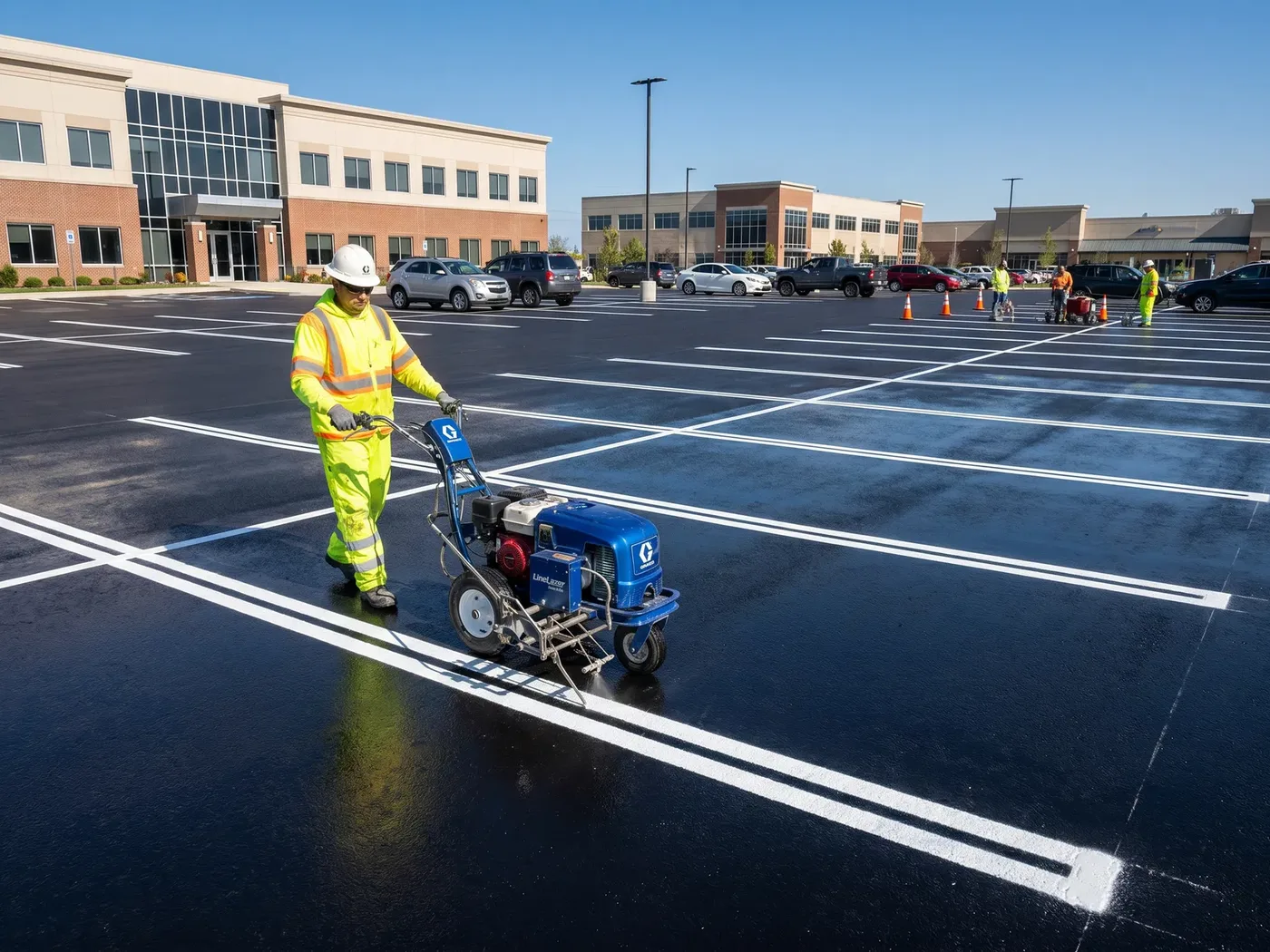
How much does parking lot striping cost in Billings, MT?
Published 2026 cost guides put a standard stall at $4 to $10 to restripe and $5 to $15 for a new layout. Line work runs about $0.20 to $0.60 per linear foot. Most whole jobs land between $500 and $1,000, and accessible stalls add $25 to $60 each.
Those are national market ranges, not our prices. A real number needs a look at the lot and a stall count. We handle parking lot striping and pavement markings around Billings and the Yellowstone Valley.
What sets the price on a striping job?
Stall count, restripe versus new layout, the stencils the lot needs, the paint, and the minimum a contractor charges to show up. Published guides price stall lines by the stall or by the foot, then price each symbol per unit.
| Line item | Published 2026 range |
|---|---|
| Stall, restripe | $4 to $10 per stall |
| Stall, new layout | $5 to $15 per stall |
| Line work by length | $0.20 to $0.60 per linear foot |
| Accessible stall | $25 to $60 each |
| Arrow, word stencil, crosswalk | $8 to $30, $18 to $35, $50 to $100 each |
| Curb painting | $1 to $4 per linear foot |
| Mobilization and minimum | $150 to $350 fee, $250 to $800 floor |
A restripe follows lines that still read. A new layout gets measured and chalked first, and a layout change adds the cost of grinding old lines off.
A 9 foot by 18 foot stall carries about 38 linear feet of 4 inch line, so a 100 stall lot is roughly 3,800 linear feet. The trip costs the same for 10 stalls as for 100, so bundling with hot rubberized crack sealing cuts the per stall price.
What does a 25, 50 or 100 stall lot cost?
Multiply the published per stall range by your stall count. At $4 to $10 to restripe, 25 stalls is $100 to $250, 50 stalls is $200 to $500 and 100 stalls is $400 to $1,000. Small lots hit the job minimum instead.
| Lot size | Restripe, published range × stall count | New layout, published range × stall count |
|---|---|---|
| 25 stalls | 25 × $4 to $10 = $100 to $250 | 25 × $5 to $15 = $125 to $375 |
| 50 stalls | 50 × $4 to $10 = $200 to $500 | 50 × $5 to $15 = $250 to $750 |
| 100 stalls | 100 × $4 to $10 = $400 to $1,000 | 100 × $5 to $15 = $500 to $1,500 |
Those rows cover stall lines. Accessible stalls, arrows, stencils and mobilization sit on top, which is why one 2026 guide puts a 100 stall restripe at $850 to $1,200 with those markings in it. We price new lot layouts and restripes off the lot.
Why do accessible stalls cost more, and how many does a lot need?
An accessible stall carries a painted symbol, blue and white paint and a hatched access aisle, so published ranges put it at $25 to $60 each against $4 to $15 for a standard stall. The 2010 ADA Standards set the count.
| Total spaces in the lot | Minimum accessible spaces |
|---|---|
| 1 to 25 | 1 |
| 26 to 50 | 2 |
| 51 to 75 | 3 |
| 76 to 100 | 4 |
| 101 to 150 | 5 |
| 151 to 200 | 6 |
| 201 to 300 | 7 |
| 301 to 400 | 8 |
| 401 to 500 | 9 |
| 501 to 1000 | 2 percent of total |
The count is figured per parking facility, and one of every six accessible spaces must be a van space.
Repainting is the trigger. Federal guidance says a business that restripes parking spaces has to provide accessible spaces as required by the 2010 ADA Standards, and the City of Billings zoning code requires the ADA minimum on all parking lots. We stripe to that count. A question about one lot goes to the City or your design professional.
How often should a lot be restriped?
Every 18 to 24 months is the published baseline for a commercial lot. Northern lots that see plows and road salt run closer to 12 to 18 months, and drive lanes get touch ups every 6 to 12 months. A sealed lot gets a full restripe.
| Lot type or material | Published figure |
|---|---|
| Office lot | Every 18 to 24 months |
| Busy retail lot | Lanes every 6 to 12 months |
| Lot with plows and salt | Every 12 to 18 months |
| After a seal coat | Complete restripe |
| Paint life | Water based latex 1 to 2 years, thermoplastic 4 to 6 years |
Billings sits in the northern column, where the City makes property owners clear the public sidewalk next to a property within 24 hours of a snow fall. If a seal coat is due, price both against what a seal coat costs here.
When can striping go down in Montana?
Both the pavement and the air need to be at least 50 degrees, and the temperature cannot drop below 50 for 24 hours after the line goes down. That is a traffic paint maker’s own rule. The window runs from late spring into fall.
A second traffic paint maker adds a ceiling: apply only between 50 and 90 degrees, with the surface at least 5 degrees above the dew point. Both put dry time near 30 minutes.
New asphalt should cure about four weeks, until the surface is free of light oils, and fresh sealer needs 24 hours before paint. Montana DOT stops plant mix paving on November 1, a fair marker for the season’s end.
What is different about striping a lot in Billings?
The City lists parking lots among the work that needs a building permit, and lists sidewalks or driveways that will not support a structure and sit entirely on private property among the work that does not. Ask the City which one applies.
The zoning code shapes layouts. Walkways between a building and an adjacent parking lot have a minimum unobstructed width of five feet, and pedestrian pathways are required through parking areas larger than forty spaces. That decides where paint goes and where concrete walks and pads belong.
The City ran its own striping job in 2025. Final striping downtown was set to begin the week of August 17 and to take 2 to 3 weeks, planned mostly at night to spare businesses, and it needed a lot of manual hand striping. Business lots get the same treatment, in sections and off hours, like our commercial paving and lot repair.
What should a striping bid list?
A stall count, a clear restripe or new layout call, the paint and number of coats, accessible stalls and aisles on their own line, every arrow and stencil priced per unit, and the mobilization or minimum shown plainly. That makes bids comparable.
Ask whether the price covers removing old lines when the layout changes, whether the surface needs a fresh seal coat first, and how the lot stays open.
We stripe lots across Billings, Billings Heights, Laurel, Lockwood and the rest of the valley. Count your stalls and ask for a free estimate on the lot.
FAQ
How much does it cost to stripe a 100 space parking lot? Published 2026 guides put a 100 stall restripe at roughly $850 to $1,200 with a few accessible stalls, arrows and stencils in it. Stall lines alone at $4 to $10 each land nearer $400 to $1,000, before mobilization and surface prep.
How much does one parking stall cost to stripe? A standard 9 foot by 18 foot stall carries about 38 linear feet of 4 inch line. Published 2026 ranges put a restripe at $4 to $10 per stall and a new layout at $5 to $15, or $0.20 to $0.60 per linear foot.
Do accessible stalls cost more, and how many does a lot need? Yes. Published ranges run $25 to $60 per accessible stall against $4 to $15 for a standard one, for the symbol, the blue paint and the hatched aisle. The 2010 ADA Standards set the count: 1 space at 1 to 25 spaces, 4 at 76 to 100.
How often should a parking lot be restriped? Most commercial lots go every 18 to 24 months. Northern lots that see plows and road salt run closer to 12 to 18 months, and drive lanes and entrances get touch ups every 6 to 12 months. Water based paint is published at 1 to 2 years.
Can you stripe right after seal coating? Not the same day. A traffic paint spec calls for fresh pavement sealer to cure at least 24 hours before paint goes on. A seal coat covers every existing mark, so a full restripe belongs in that job rather than a later one.
When is it too cold to stripe in Montana? Traffic paint makers set the floor at 50 degrees for both the air and the pavement, with no drop below 50 for 24 hours after. One spec adds a 50 to 90 degree window and a 5 degree margin over the dew point.
Want a number for your own project?
We look at the job in person and hand you a free written quote across Billings & the Yellowstone Valley.